
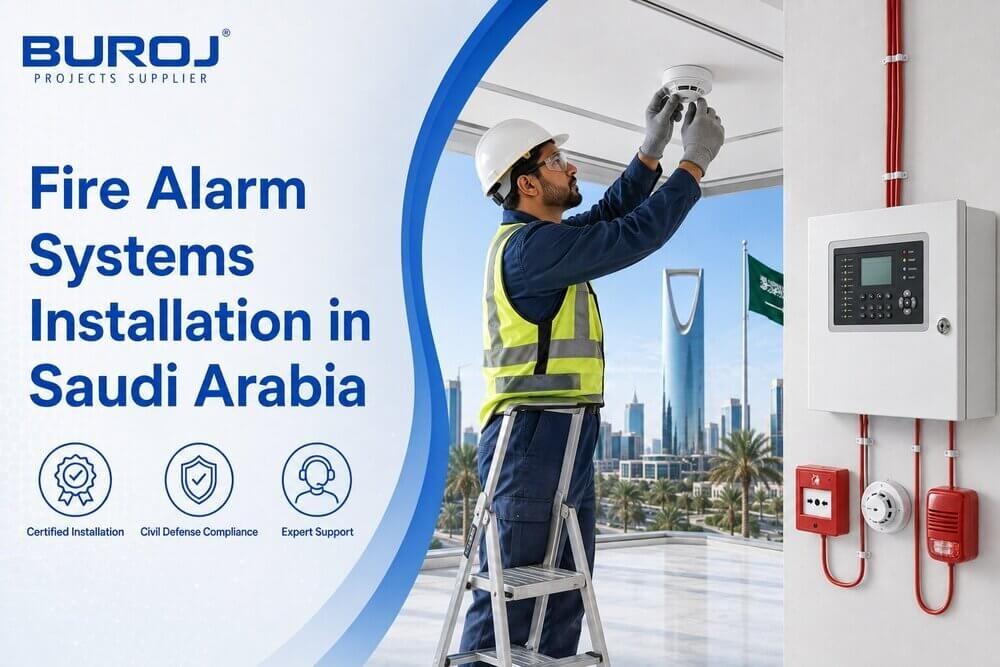
Fire alarm systems installation involves designing, wiring, and configuring fire detection devices to detect fires early and protect building occupants. At the center of every system is the Fire Alarm Control Panel (FACP), which receives signals from detectors and activates alarms when needed. This guide covers types of fire alarm systems, key components, fire alarm wiring diagrams, and essential installation requirements for compliance in Saudi Arabia.
What Are Fire and Alarm Systems, and Why Do They Matter?
Fire and alarm systems are networks of interconnected devices built to detect fire hazards and alert everyone in a building before things get out of hand. A basic setup includes detectors, notification appliances (sirens, strobes), and the control panel that ties it all together. Proper fire alarm installation makes sure every one of these pieces is wired, configured, and tested to work together when it counts — not just installed and left alone.
Here's what a properly installed system actually does for a facility:
Early detection — Detectors sense smoke, heat, or flame and relay signals to the panel before a fire spreads.
Occupant alerts — Once a fire is confirmed, the panel triggers audible and visual alarms so people can evacuate immediately.
Suppression activation — Sprinklers, gas systems, or manual extinguishers kick in moments after the alarm sounds.
Emergency communication — Many panels can auto-dial civil defense or on-site security for a faster response.
Fault monitoring — The panel keeps an eye on its own health, flagging wiring faults, dead batteries, or failed detectors before they become a problem.
Types of Fire Alarm Systems installation
1. Conventional Systems
The oldest and still one of the most widely used types, mainly because they're cheap to install and reliable.
Pros: Lower installation and maintenance cost, more affordable hardware, dependable performance. Cons: Can't pinpoint which exact detector triggered the alarm — only the zone, slower response overall, and a poor fit for large or complex buildings.
2. Addressable Systems
Common in larger facilities where speed and precision matter.
Pros: Identifies the exact device that triggered the alarm, faster response, easy to expand as a building grows. Cons: Higher upfront and maintenance cost, and commissioning takes longer.
3. Wireless Systems
The newest approach, using secure wireless links instead of cabling between devices.
Pros: Fastest to install, flexible for future upgrades, no need to run cable through finished walls. Cons: Batteries need regular replacement, and there's some risk of interference from other wireless systems nearby.

Key Components of a Fire Alarm System
A fire alarm system is more than a single horn on the wall — it's a set of parts working together:
Fire Detectors — Smoke, heat, or flame sensors that are the system's first line of defense.
Control Panel — The hub that receives detector signals, processes them, and issues commands.
Notification Appliances — Sirens, horns, and strobe lights that alert occupants.
Manual Call Points — Pull stations that let someone trigger the alarm by hand if automatic detection lags.
Communication Systems — Optional but valuable in larger setups; auto-notifies civil defense or facility management.
Fire Alarm Fitting: What the Saudi Building Code Requires
According to the Saudi Building Code (SBC), fire alarm fitting has to follow a specific set of standards, not just "wire it and walk away":
- Detectors must comply with both international and Saudi standards for sensitivity and reliability.
- The building must be divided into fire zones so a fire's location can be identified quickly.
- Coverage must extend to every critical area of the building — no gaps.
- Alarm devices must connect to a backup power source for uninterrupted operation during outages.
- Maintenance must be carried out exclusively by certified entities.
- Facility staff must be trained to operate the panel, trigger suppression systems, and use extinguishers correctly.
Also Read: Best Fire Alarm Cable Types & Prices In Saudi Arabia
Fire Alarm Wiring Diagram: Addressable vs. Conventional
A fire alarm installation diagram lays out how detectors, notification devices, and the control panel are physically connected — and the wiring approach differs significantly between system types.
Addressable Fire Alarm System Wiring Diagram
In a fire alarm addressable system wiring diagram, devices are wired in a loop: two wires leave the panel, pass through every detector and device on that loop, and return to the panel — forming a closed circuit. Each device carries its own address, so if one unit fails, the loop can often keep functioning through an alternate path, and the panel still knows exactly which unit is down. A single loop can typically support well over a hundred devices depending on the manufacturer, which is one reason addressable systems scale so well in large buildings.
Conventional Fire Alarm System Wiring Diagram
A conventional fire alarm wiring diagram is wired by zone instead of by individual device. Each zone is a separate circuit run from the panel, with a batch of detectors and call points wired onto it — typically limited to around 20 to 32 devices per zone, depending on the panel. When any device on that circuit triggers, the panel identifies the zone, not the specific detector, which is why conventional systems only narrow a fire down to a general area rather than an exact point.
Step-by-Step Fire Alarm Installation Process
Choosing the right panel location and following the correct sequence is critical for both compliance and system reliability:
- Choose an easily accessible location — reachable by both occupants and civil defense personnel.
- Position it near the main entrance for quick access during an emergency.
- Avoid crowded areas that could slow down access to the panel.
- Keep it away from hazards — extreme heat, electrical panels, or rooms with chemicals or flammable gases.
- Install at the correct height — Civil Defense guidelines call for 1.5 to 1.8 meters above the floor.
- Connect a backup power source so the system keeps running during a power outage.
- Ensure proper ventilation — a location with good airflow, away from humidity, prevents the panel from overheating.
Why Regular Maintenance and Testing Matter
Installing the system correctly is only half the job — routine maintenance is what keeps it reliable:
- Early fault detection catches wiring or component issues before they become emergencies.
- Performance testing during maintenance visits reveals weak points before they fail when it matters.
- Battery and sensor replacement on schedule keeps every component functioning as designed.
- Lower long-term repair costs, since small issues caught early are cheaper to fix than system failures.
Read more: Lighting Control System Solutions by El Buroj: Smart Technology for Modern Saudi Projects
Sourcing Fire Alarm System Components from El-Buroj
Installing and wiring a fire alarm panel is work that must be carried out by a Civil Defense-certified fire systems company — it's not a DIY job or something a materials supplier should take on. What El-Buroj does provide is the full range of fire protection products your certified installer will need: fire extinguishers, pumps, valves, fittings, fire cabinets, and related fire alarm components, all at competitive pricing and sourced from trusted brands.
Contact our team for pricing on fire protection products via WhatsApp or by calling 920031298.
Frequently Asked Questions
What are the components of a fire alarm control panel?
A fire alarm control panel consists of the control unit, a backup battery, fire detectors, and alarm devices.
How many detectors can be connected to a control panel?
This depends on the panel type. Conventional panels typically support 20–32 detectors per zone, while addressable panels may support 99–250 devices per loop depending on the manufacturer.
What's the difference between an addressable and conventional wiring diagram?
A fire alarm connection diagram helps technicians understand how detectors, notification devices, and the control panel are interconnected. In an addressable fire alarm system wiring diagram, each device has a unique address, while conventional systems rely on zone-based circuits.
Does a fire alarm control panel require maintenance?
Yes — monthly maintenance is recommended to keep the system efficient and ready to respond during an actual emergency.
Can a fire alarm control panel function during a power outage?
Yes, as long as it's connected to an integrated backup battery, which keeps it running through an outage.
What affects the cost of fire alarm system installation?
System type, number of devices, building size, and labor costs all play a role — costs typically range from around 5,000 for small setups to over 50,000 for large, complex installations.